Robotics Digital Twin for Kitchen Staff Duties
A humanoid robotics programme for commercial kitchen duties, including clearing stations and loading and unloading the wash. Proposed duties are reviewed for the intended venue before a physical trial is considered.
- IndustryFood service and commercial kitchens
- Type of workOwn build, in progress
- StatusIn development for commercial kitchen duties
Commercial kitchen duties under evaluation
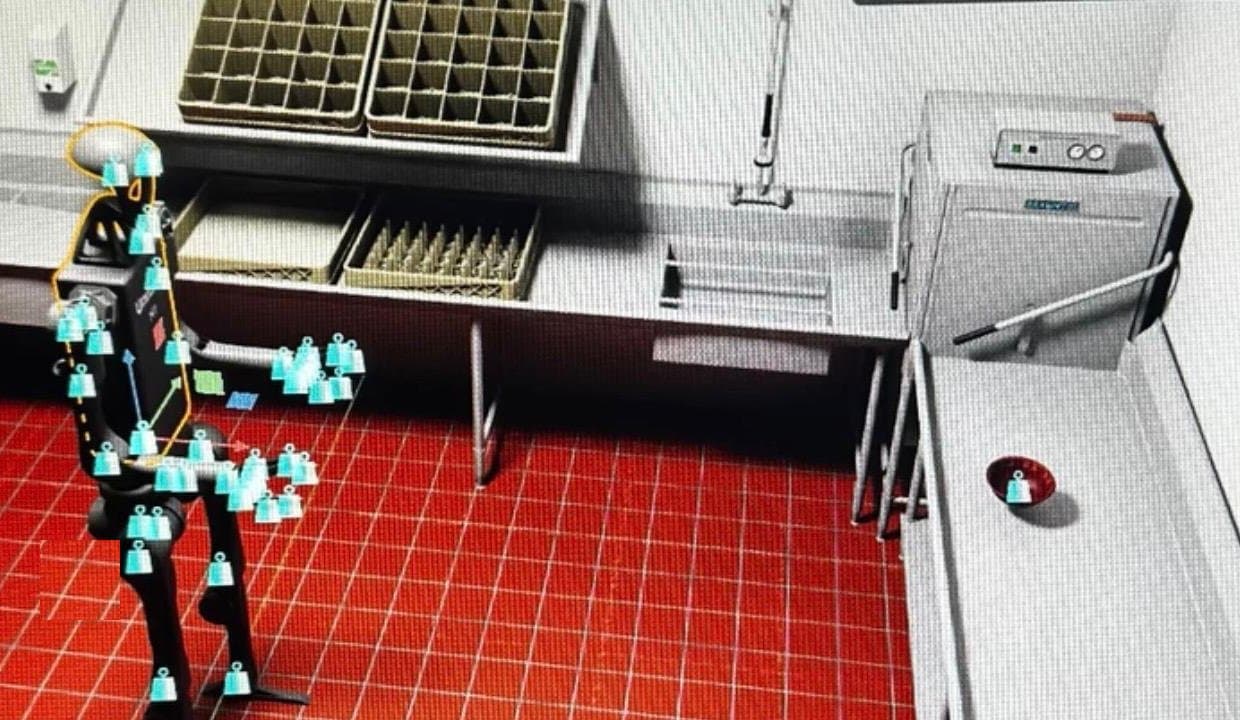
A commercial kitchen runs on the duties nobody wants at the end of a shift: clearing a station, wiping down, loading and unloading the wash, putting everything back where the next service will look for it. We are building a humanoid for that work. What we treat as the real product is not the robot, it is the rebuild of the venue the robot learns in.
The programme evaluates the intended duties and the requirements of each venue.
Why this is the hardest room to hand to a robot
These are the duties a kitchen struggles hardest to keep staffed, and the room they happen in is the least forgiving one in the building.
The work nobody wants to be rostered for
Clearing and cleaning land at the end of a long service, they are physically hard, and the roles that carry them turn over faster than the rest of the room. That pressure is what makes automation worth attempting here at all.
A room that punishes a wrong move
Wet floors, hot surfaces, blades, glass, and people moving quickly past each other in a narrow space. Anything introduced into that has to behave when it is surprised.
New equipment reopens the hazard analysis
Putting anything new where food is prepared reopens the hygiene and hazard assessment for the whole line. That is a design constraint from the first week, not a certificate chased at the end.
Rehearse in a rebuild of the room, then review
There is no version of this where a robot learns on the floor during service. So the room is rebuilt, the work is rehearsed there, and the gate it has to pass is there too.
The venue rebuilt, so nothing is tried in the real room first
The venue is rebuilt from a walkthrough so that the work can be rehearsed there before any trial in the real room is considered. A failed attempt costs a run, never a wet floor.
- Surfaces, fixtures and clearances carried over as they are
- Doors, drawers and appliance handles work as they do in the room
- Rebuilt for the venue it is meant for, and again when the room changes
Rehearsal at a volume the real room cannot supply
The duties are rehearsed in the rebuild far more times than a working kitchen could ever allow.
- Clearing stations
- Loading and unloading the wash
- Putting a station back for the next service
Behaviour that survives a room on a bad day
The programme explores the kitchen duties a robot could support, in the rebuild of the venue it is meant for.
- Suitability for the intended venue reviewed
- The awkward cases included
- Built for the venue it is meant for
The review it has to pass first
Review is a stage with its own gate: suitability and safety for the venue are checked before any deployment is considered.
- Planned duties reviewed
- Safe stopping part of the review
- Difficult operating conditions considered
What rehearsing first changes about the risk
The programme evaluates proposed kitchen duties in a reconstruction of the intended venue before a physical trial is considered.
Before the door
Where mistakes land
In the rebuild a failed attempt costs a run. In the room it costs a wet floor, a dropped tray, or a person in the way. The expensive version of the mistake is the one that never has to happen.
Per venue
How it is meant to scale
Behaviour proven in one room does not carry to the next one by itself, so the rehearsal is rebuilt for each venue instead of being sold as a robot that works anywhere.
Reviewed first
What clears a release
Nothing enters the building on the strength of a good demonstration. It enters when the review is passed.
Considering automation in a room where a mistake is expensive?
The useful first conversation is about the space, the duties, and the constraints they have to respect. Tell us what the room does, and we will be straight about what is rehearsable today and what is not.
Discuss your project