Music Company Internal Tool
A music company's artist and repertoire team decides every morning which tracks deserve attention. This platform answers that question from a history it keeps itself, ranks tracks on whether their momentum is building, and turns a decision into a finished vertical clip on the company's own hardware.
- DomainMusic business, artist and repertoire
- EngagementInternal platform build, data platform and video studio
- StageIn daily use
A history the company keeps itself
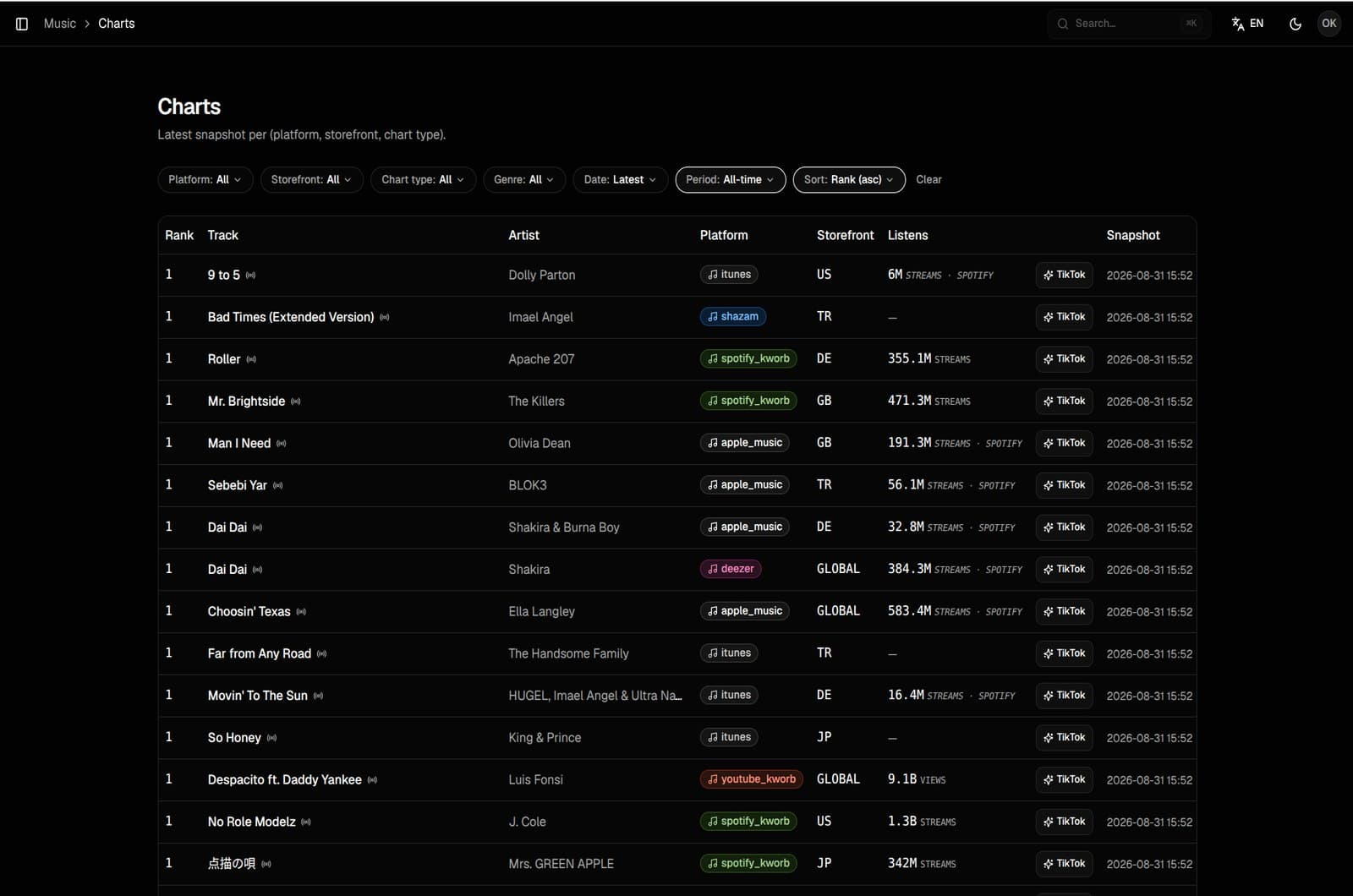
Chart positions and, where a source publishes them, listen counts are collected on a schedule from the major platforms and storefronts, and every daily reading is retained with a record of where it came from, so any answer the platform gives can be traced back to its source. A missed day is caught up, and a source that fails does not stop the rest of the snapshot.
The second half is a production studio that turns a chosen track into a finished vertical lyric clip with generated imagery, on the company's own graphics hardware.
A market picture assembled by hand every morning
Everything needed to decide what to work on was published somewhere. None of it was in one place, and none of it was retained.
Chart data collected by hand
Positions were read from one platform dashboard after another and copied into a spreadsheet. The picture was complete around the time it stopped being current, and the same work started again the next day.
No history, so no momentum
Without a retained record of previous days, a track climbing quickly and a track standing still looked identical. Movement existed only in individual memory and could not be queried after the fact.
Acting on a decision cost a day of production
Once a track was worth promoting, producing the clip was separate production work, and that cost meant most decisions were never acted on.
A data platform and a production studio in one tool
A data side that keeps the history and ranks movement over it, and a studio side that turns a decision into a finished clip.
A history the team no longer assembles by hand
The platform takes its own reading every day, on a schedule, across the major platforms and storefronts, and retains all of them, so the history grows without manual work.
- Chart positions across the major platforms and storefronts, with absolute listen counts wherever a source publishes them
- Every reading retained with its source, so an answer can be traced back
- A failing source is skipped and recorded, and a missed day is caught up
Tracks to review alongside their history
Movement is computed over the retained history, ranked and scored per genre and storefront.
- A climb is visible before it becomes a top position
- A momentum board that ranks by how attention is changing
- A breakout list that flags a track only while the evidence agrees
A studio for finished vertical clips
A track goes in and a finished vertical clip comes out, with every step recorded so an operator can see what was decided.
- A finished vertical lyric clip
- Timed lyrics the operator can review and correct
- Scene imagery generated to the lyrics, rendered vertical with animated text, with and without the music
One dashboard for both halves
A single interface shows what the data says and what the studio is doing at the same time.
- Chart drill-downs, a rank ladder per track and a heatmap view, all addressable by link so any view can be shared
- The production pipeline started from the dashboard with progress streamed stage by stage, and a run history beneath it
- A timeline editor for word timing and overlay placement against the vertical frame
What changed for the team
Track histories and clip production in one workspace.
Retained
A record instead of a snapshot
Each day's positions and counts stay, so a question about movement can be asked after the fact instead of depending on who remembers last week.
Earlier
Attention while a track is still climbing
The team reviews tracks that are gaining, alongside their history, while they are still climbing.
Repeatable
Repeatable clip production
The studio prepares vertical lyric clips on the company's own hardware, with timing and imagery available for the operator to review.
Talk to us about your morning question
If the answer you need already exists in several places and somebody assembles it by hand every day, that is usually one internal platform. Tell us what the question is.
Discuss your project